
petri by Lux Cache
a generative sample environment — map your library, generate new sounds, design the shape of them, play the results.
Lux Cache Full Access subscribers and studio+ bundle owners get petri for $89 — $10 off the list price.
petri is a sample-library environment built on four things: map, generate, design, and play. It maps your whole library so sounds are found by ear, generates new samples from the material you already own, lets you shape any one of them by hand, and plays and sequences all of it in one place. Four equal parts of one environment, and each one feeds the next.
browse by ear, not by filename
petri turns your whole library into one living map: every sample a single cell, and similar sounds settling into colonies, so browsing happens by ear rather than by filename. searching turns into browsing, and material you’d forgotten you owned becomes findable again.
the map
every sample a cell in one view, coloured by type: kick, bass, snare, clap, hat, perc, tonal, fx. hover one to hear it instantly, from a few hundred samples up to tens of thousands.
also a list
the same library as a searchable, sortable table alongside the map: filter by type, sort by name or length, select several sounds and drag them all out together.
two ways to arrange it
let petri cluster the map purely by how things sound, colonies of similar material forming on their own, or steer it by hand so the axes mean what you want: bright to dark, short to long.
find by example
pin a sample as a reference and petri re-ranks the rest of the library by how close it sounds, each result carrying a match figure.
find by description
type what you are after in plain words and petri lights up the matching samples on the map. no tagging or naming required.
fast to live in
drop in new WAVs and petri analyses them and settles them into place automatically. a library reopens in about a second.
over 2000 sounds to start from
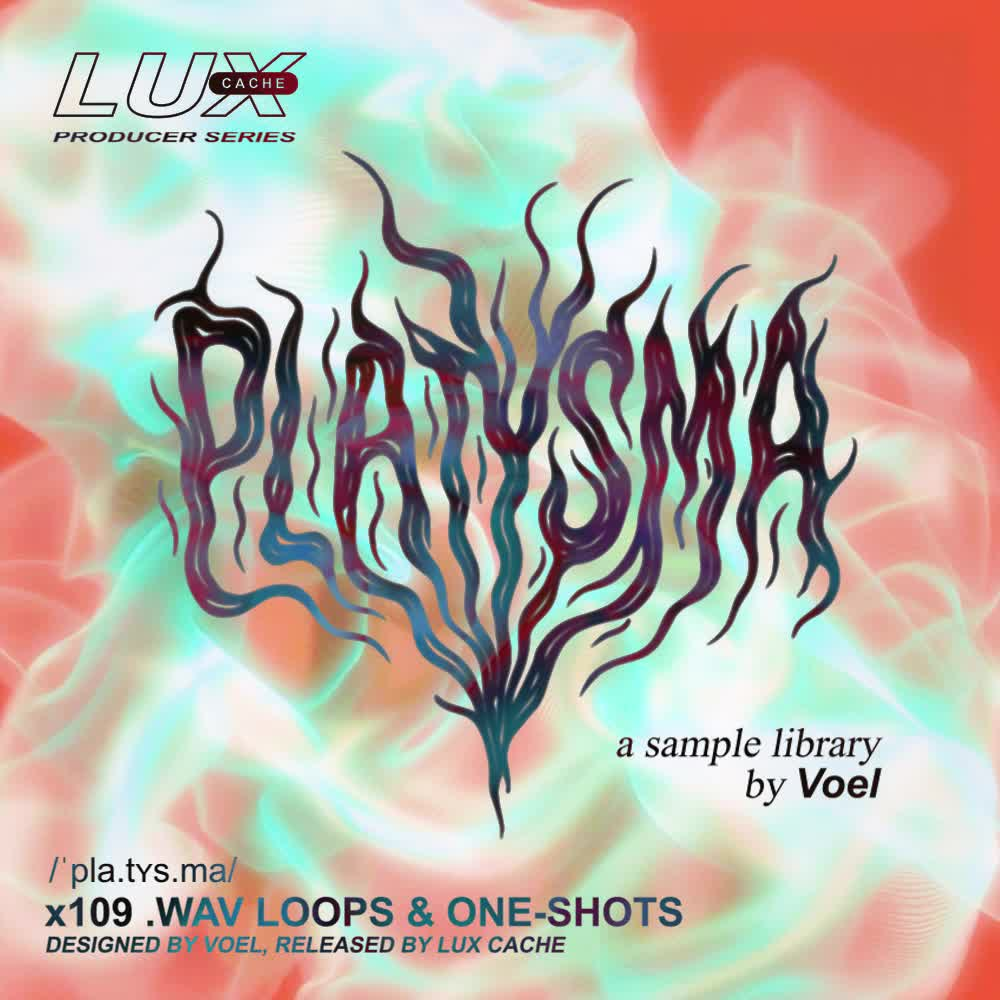
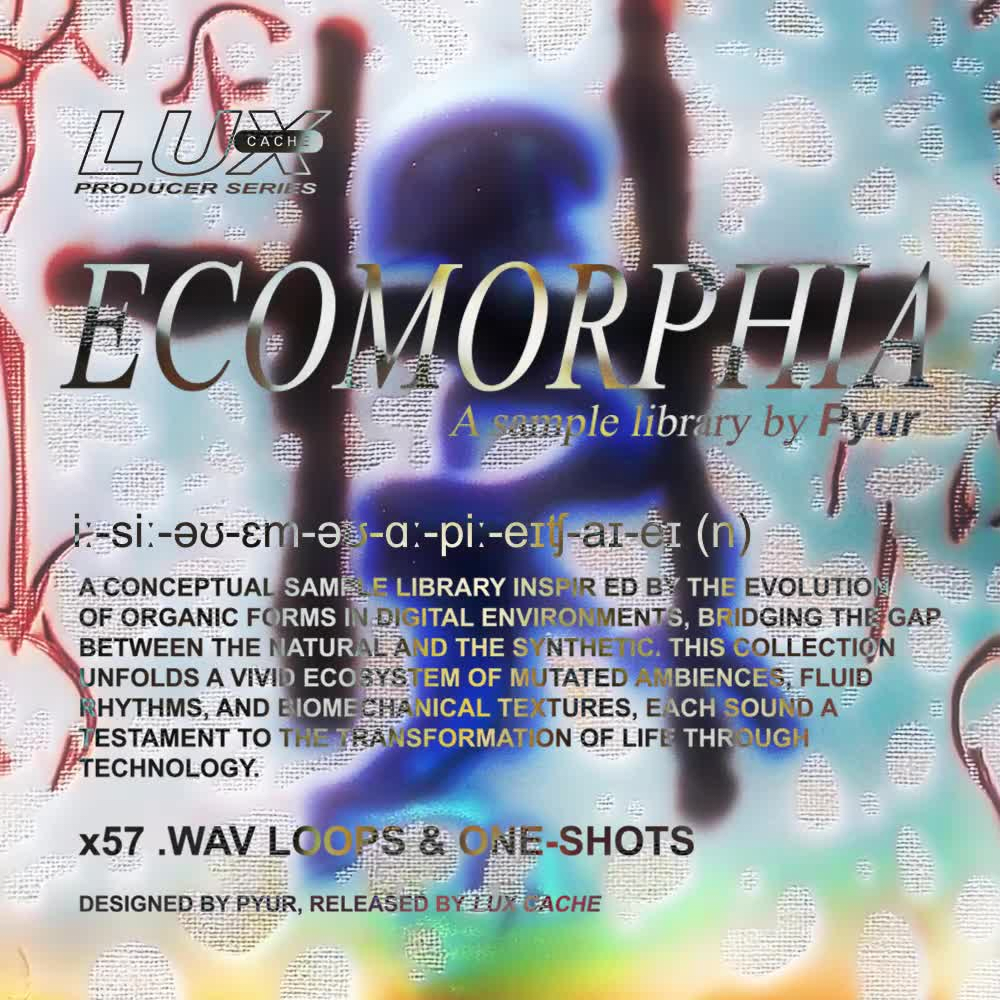
petri comes with every Lux Cache Season pack, an archive of experimental sound design samples going back to 2020. The free demo comes with a taster set: a starting culture for petri to map, generate from and play, right from first launch.





or add your own
drag in a folder of WAVs, or point petri at the sample library you already have. it analyses what you drop, settles it onto the map alongside the packs, and it’s ready to generate from.
four engines to generate sounds
petri's four engines take samples already in your library and make something new. nothing comes from a preset bank. the results carry the character of what they came from, which keeps a session coherent.
cross two or three samples into one
spawn makes the child four ways. morph blends the parents into one body; graft joins one parent’s attack to another’s body and a third’s tail; cast rings one sound through another; ring modulates one with the other. A kept child can be bred from again, so sounds develop across generations.
- four modes
the modes sit as a row of words at the top of the rail. every child keeps the one that made it, down to its filename.
- the family tree
every cross keeps a visible lineage, so a sound family can be retraced or branched off again.
- further adjustment
a child can still be reshaped before it seeds again: tilt and width in every mode, plus two dials that belong to the mode it was bred in.
design your samples
take any sound off the map, draw your processing onto its waveform, and save the result back into your library.
ten blocks, drawn onto the wave
sample studio+’s sound design, inside petri and pointed at the sample under your cursor. every block is a region you place, with its own automation curve across it — a filter that only closes over the tail, sub weight on the first few milliseconds, a grain stretch on the last third.
punch, or a duck
weight underneath
a bright sweep
takes the top off
breaks harmonics apart
air and grit
bends it up or down
stretches it longer
strips the root away
diffuses it into tails
- a stretch of the sample
each block covers the part of the sound you put it over: move it, resize it, bend its curve, fade its edges.
- render and keep going
flatten the chain into the sample and the three slots free up, so the next pass builds on the last.
- export as a child
the result saves into your library beside its parent, carrying its parentage, or drags straight into your DAW.
or roll the dice and let it build the chain for you.
play what you make
everything petri generates is a real, playable sample the moment it exists, so petri is also an instrument and a sequencer, not just a generator.
the library across a keyboard
petri maps the library across a MIDI keyboard four ways — an unpitched ladder, a chromatic instrument that tunes pitched samples on the fly, a block per sound family, or an auto-built drum kit. lock a sound to one key and the keys around it fill with similar timbres.
- four layouts
tonal, bright, family and drums: pick how the library lands on the keys.
- auto-built kits
a full drum kit assembled from the library in one press, with a dice to re-pick every slot.
- saved kits
layouts save as named kits, so a keyboard you like is one click away next session.
built for experimentation
alongside mapping, generating, designing and sequencing — petri transforms your library into a sound design gesture itself.
the audition rail
one shared set of controls sits under every preview petri plays, from the map to the keys to the engines, so a sound is heard the way you’d actually use it.
- one rail for everything
level, width, pitch and voices. the same shaping sits under every preview, map to keys.
- per-hit dice
pan, velocity, start, pitch, filter and reverse each take an amount, so no two hits land the same.
- envelopes and scale-snap
drag amp, filter and pitch envelopes, quantise the trigger, and snap tonal material to a root and scale.
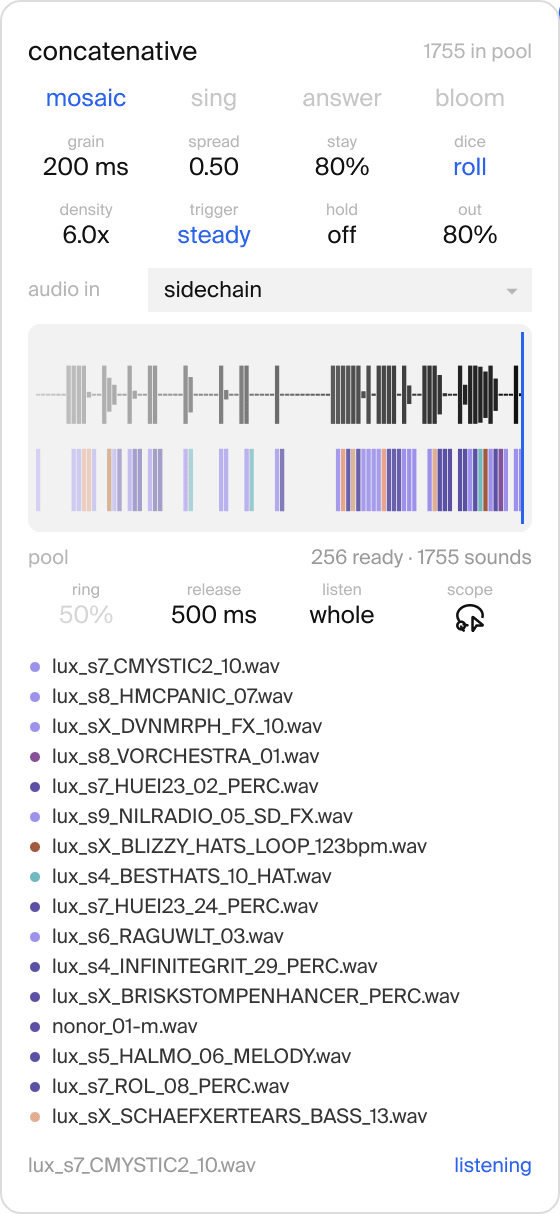
the concatenative rail
play audio into petri and it answers in real time with sounds from your own library: a drum loop re-laid as a mosaic of your samples, a bassline sung back in the library’s own voice.
- four ways to answer
mosaic re-lays your input as tiles of your library; sing pitch-tracks it; answer replies hit for hit; bloom lets the tails escape.
- your library is the voice
every grain that comes back is a file you already own, matched against what it heard as it arrived.
- in from anywhere
a sidechain input on the plugin, or open a mic or interface directly from the rail. lasso a region of the map to decide what may answer.
the record rail
a session-wide recorder: everything petri puts out, auditions, keys, sequences and engine output, lands in the same takes list, captured as WAV.
- always one press away
record, pause, stop. no arming, no routing, whatever the environment plays goes to the take.
- it was already listening
a rolling minute of everything petri makes is kept whether the recorder was armed or not. one press turns the jam you didn’t record into a numbered take.
- straight to the DAW
any take, any sound in petri, drags out of the window and lands as a file.
when you know what you’re after
petri’s map is for browsing. these two are for hunting: a table when you think in names and types, and a ranked rail when all you have is “like this one”.
the list
the same library as a sortable table beside the map: filter by type, sort by name or length, multi-select and drag a handful of sounds out together.
suggest similar
pick any sound and the library re-ranks around it: nearest first, each result carrying a match figure. it works from a rail on the map or straight from a row in the list.
petri / minis
Three of petri’s rails also sell as their own small plugins. Buying petri gets all three of them.


Bought on their own they are $29 to $39 each. A petri licence covers all three, so there is nothing extra to buy. See what each one does.
your sounds, endlessly recombined.
- —the petri Standalone app + VST3 / AU plugin
- —macOS · Windows
- —every Lux Cache Season pack, included from first launch
- —petri / keys, concatenative and design, the three minis, included
- —lifetime updates
- —a 7-day free trial to Lux Cache
Lux Cache Full Access subscribers and studio+ bundle owners get petri for $89 — $10 off the list price.
VST3 / AU plugin + Standalone for macOS and Windows. Secure checkout via Stripe. Pay in your local currency. Try the whole thing first with the free demo.