
chassis by Lux Cache
a semi-modular synthesis system: thirty-four experimental modules to patch, sequence and roll into something new, as an instrument or on a track.
Lux Cache Full Access subscribers and petri owners get chassis for $69, $10 off the list price.
chassis is a semi-modular synthesis system designed to turn into something else when pushed. Inspired by the philosophy of bricolage, each of its 34 modules explores a multitude of angles; all experimental in nature.
A modular synth is built from separate parts joined by cables. Any output can feed any input, so the instrument is whatever gets patched. Semi-modular means some of those connections are made already. In chassis, four buses carry the tempo, the key, the notes being played and the incoming audio to every module, and every module keeps its place in one fixed layout. A cable pulled across to whatever sits nearby is already in time and in key, so a wrong turn usually still sounds like something, and plenty of good patches start that way.
In chassis, the set of modules is fixed. Every patch loads on every machine, the manual inside the plugin covers all of it, and the randomisation dice know what it is wiring, and chassisFX can bypass synthesis entirely inside every patch. Within that limit, chassis aims for depth: a system small enough to learn completely, where a patch built for one job can be pushed into another.
every face in the system
Every module below does more than one job. Each has its own modes and settings, so the same face can be set up several ways.
synth voices & sampling
7 modules where the sound is made, whether it starts at an oscillator or off the disk.
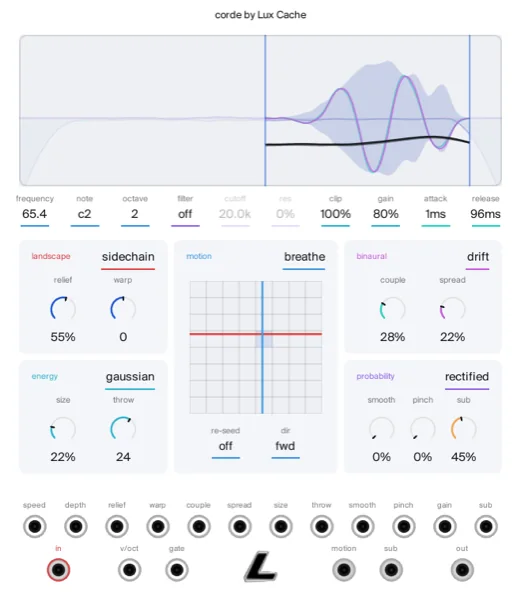
corde
a synth voice that moves by itself. a packet travels across a field and is read out as a wavetable. two fields drift apart for the stereo, six landscapes and six motion shapes steer it, and audio patched into its inputs shakes the terrain the sound moves through
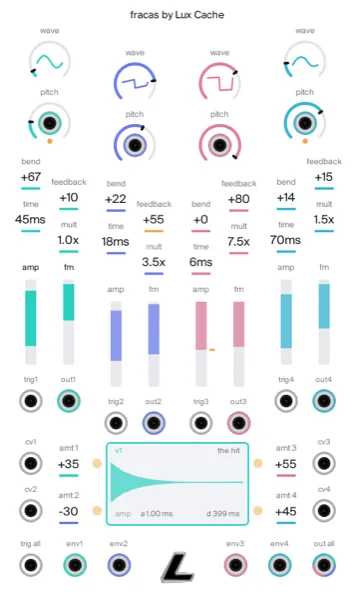
fracas
four FM percussion voices, two operators each, and a router that sends any of the four CVs anywhere inside them. feedback runs a voice from clean tone to broadband hiss, wave morphs sine to saw, and bend and time set the pitch swoop
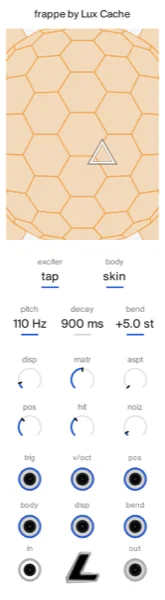
frappe
a struck object rather than a sample. choose the tiling, the size and the mallet, and it rings the way that shape would. nine objects and nine strikes, tap to bow, and a patched sound can ring the object with no mallet at all

scie
a polyphonic supersaw: up to sixteen saws a voice, detuned and spread across the stereo image, with a rounded sub underneath. blend tilts the stack from a focused centre to a hollow wall, and the pitch cable sets the polyphony

ton
four oscillators sharing one note: sine, triangle, saw and pulse, and the wave is chosen by which output the cable leaves from. each section has its own tune offset, so one key plays a chord, and a section tuned low becomes an LFO
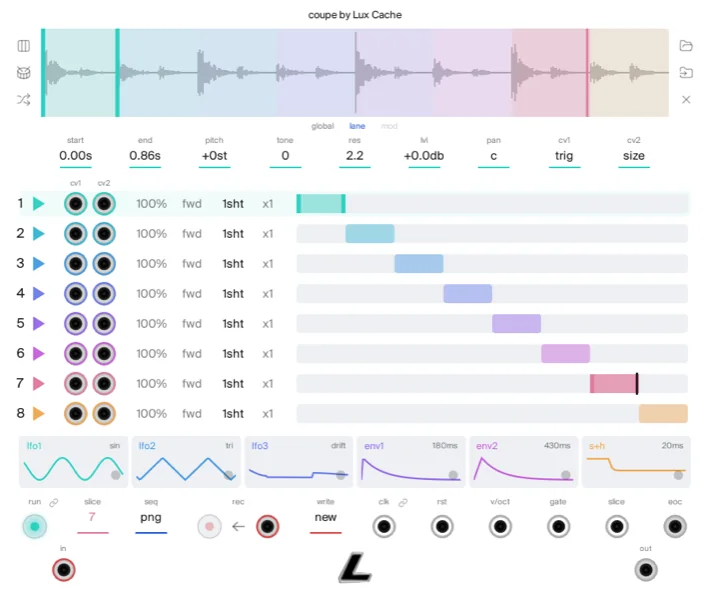
coupe
the eight-head chain sampler. heads hand off down the chain, each with its own region, speed and direction. seven sequence modes, two of them playing slices from the keys, a transient slicer, six modulators with CV outputs, and it records its own takes
bac
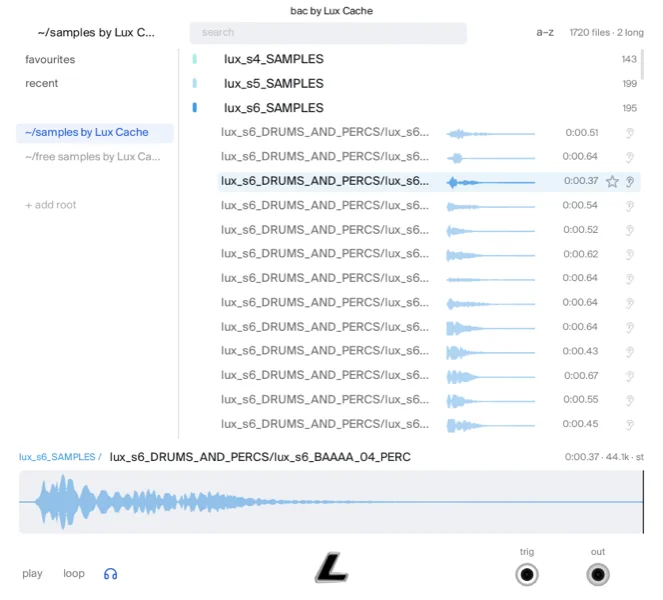
the sample browser. audition a file, then drag it straight into coupe or out to the desktop. every row draws its own waveform, the ear ranks the whole library by how a sound behaves, and the arrow keys step and audition row by row
sequencing
5 modules that decide when a sound happens, and on what note.
xtrack
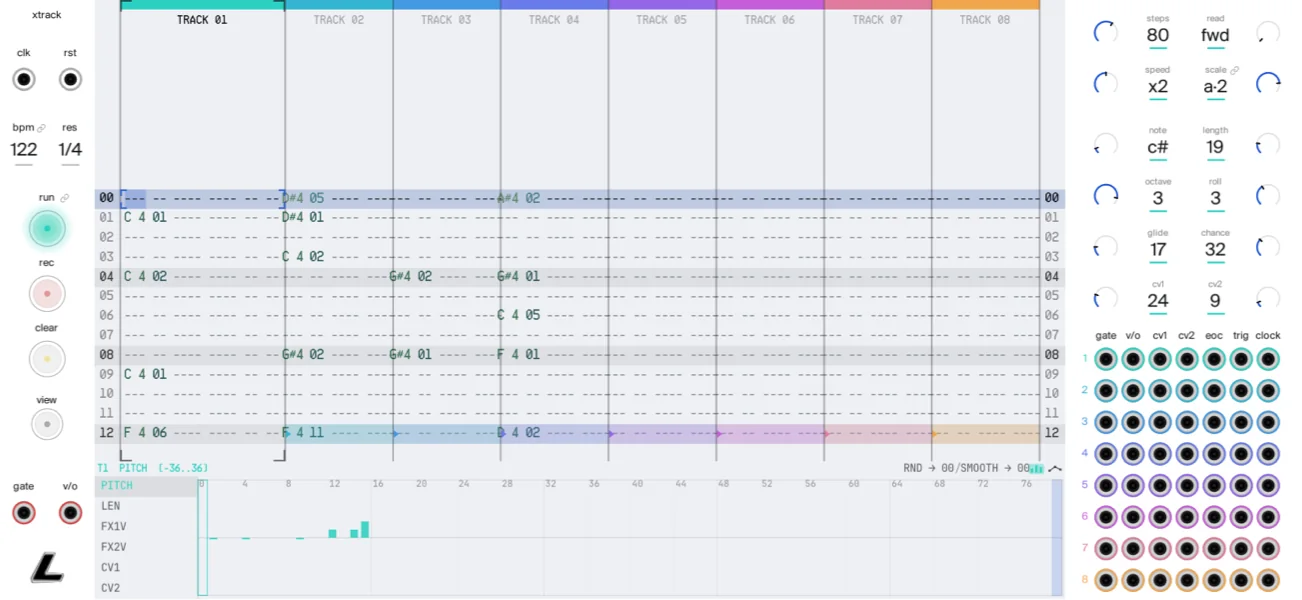
the eight-track tracker, with a note, two CVs and ratchets in every cell. the same pattern opens as a grid, a piano roll or an overview, with six automation lanes and per-track length, speed and direction. it leads the system’s transport
clavier
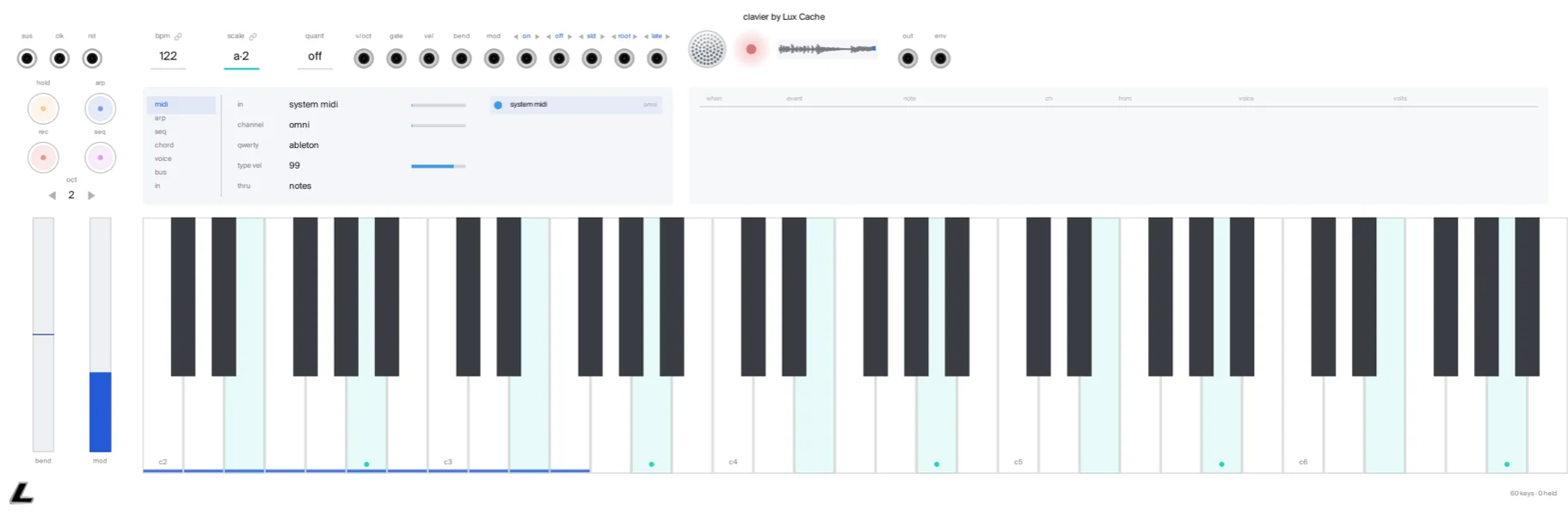
the system’s keyboard: poly keys, a phrase player, an arp, and a microphone that sings straight into the patch. one key plays up to five notes, the arp has nine modes, eight phrases hold sixty-four steps each, and five assignable outputs cover twelve jobs
grille
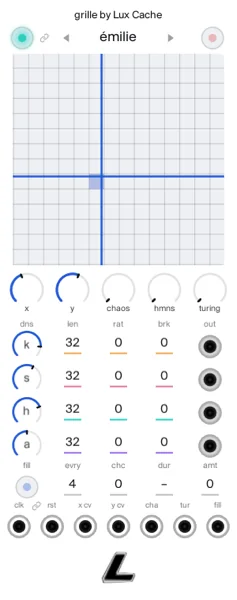
the drum computer. four lanes read off a two-dimensional map, so a pattern morphs as it travels across instead of repeating. seven banks, per-lane density, ratchets and break to its own bar length, a fill window, and turing to hold or renew the dice
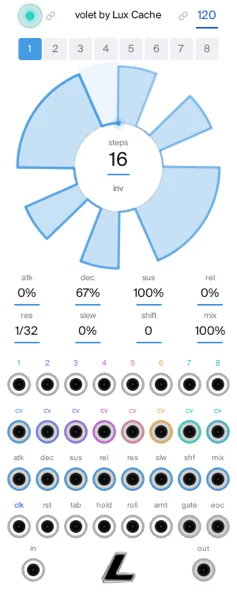
volet
an eight-channel trance gate, every channel a wheel of steps with its own shape, depth and rotation. lengths and resolutions are per channel on one shared counter, so they run as a polyrhythm, and every lane output sends gated audio or a gate voltage

xarrange
sixteen scenes for the tracker beside it. queue one and the whole pattern swaps on the bar, or as fine as a sixteenth of it. five chain modes play the scenes through on their own, loop scene holds one, and CV picks the scene
effects
9 modules that change a sound after it exists.
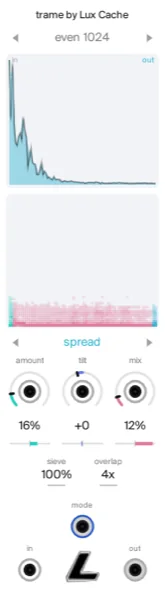
trame
sixteen spectral effects on one transform. each is its own DSP rather than a morph, and the three rings change job with each one. a CV jack steps the effect, follower bars drive the rings from the audio, and sieve keeps only the loudest bins
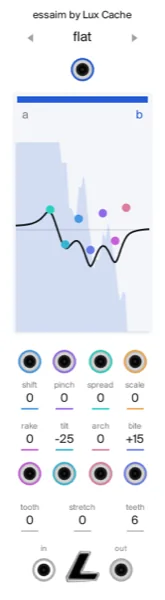
essaim
a swarm of resonances moved as one thing. place the seven nodes, then travel between two whole states on one bar. rake adds up to twenty-five more on a harmonic series, ten presets fill the far end, and auto wander moves it on its own
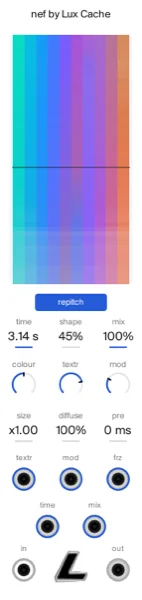
nef
a reverb: velvet noise in front of a feedback network, a tenth of a second to a minute. wind texture down and it is a scattered multi-tap delay, a volt on the time input doubles the room, and a gate freezes the tail without loss
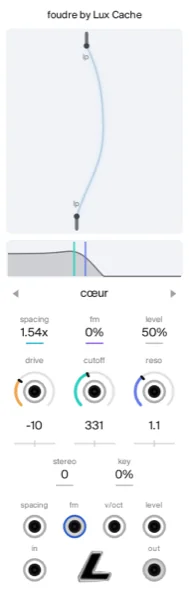
foudre
a dual filter with the drive inside the loop. série stays clean, boucle closes it and the filter becomes an oscillator, cœur and meute sit between. its own follower moves three controls with no cable, and key tracking plays it in tune from the keys
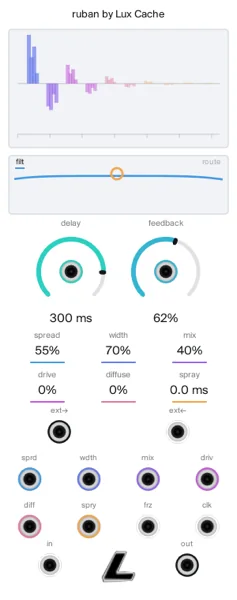
ruban
a bucket-brigade echo where time and tone are one number: a comb down low, tape up high, and past unity it sings. four heads set the rhythm and the width, and a send and return puts another module inside the loop, repeating on every pass
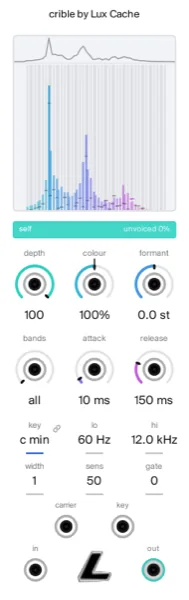
crible
a filter bank: a vocoder one way, a scale sieve the other, with the bands on the notes of a key. the carrier is the input itself, a patched cable or a saw in key, and ring narrows the bands until only the key rings through
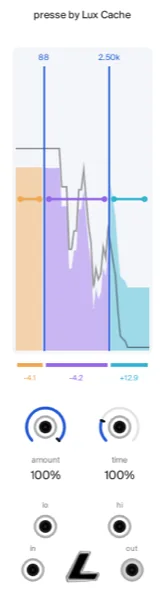
presse
three-band compression that works both ways, the quiet lifted as the loud is pulled down, band by band. amount and time scale the fixed settings, crossovers and band gains are dragged on the picture, and any band can be switched off to pass untouched

pli
an asymmetric waveshaper: the two sides of the wave bend by different amounts, which opens true stereo width. bend and pivot both make even harmonics, knee blends into a hard clip, and a crossover keeps the top end clean

biais
a frequency shifter with a delay in its loop. every partial moves the same hertz, so the pitch stays and the tuning goes. feed sets the staircase, spread sends the channels opposite ways, and dir at centre gives ring modulation
mixing
5 modules where the sound is balanced and sent out.
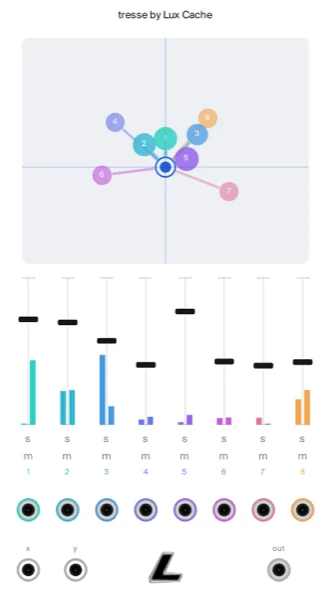
tresse
eight stereo channels standing in a room around the listener. distance is level, and moving the listener moves the whole mix. post-fader meters, mutes and solos on every channel, a limiter on the output, and a walk that sets the listener wandering

brin
a channel strip for one strand of tresse at a time: EQ, filters and a compressor, ahead of the fader. all eight run at once, and the ladder shows each channel’s response and live gain reduction, with a pan that rotates the stereo pair

envoi
one stereo send and return shared by all eight channels, tapped before or after the fader. each channel has its own send amount, the display reads the setting against what is really going out, and the return has its own level
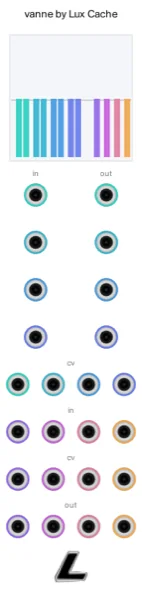
vanne
eight stereo rows of in, mode, CV and out, with a sum jack under them. each row works as a VCA, an attenuverter, an offset, a slew, a rectifier, a sample and hold, or off. one CV can feed every row below it, and the response bends from straight to exponential

sortie
the master out and the recorder. the mix leaves for the speakers, the DAW and the disk. grab records when signal arrives, take holds the last minute until saved, and tape speed shifts the system in pitch and time
utility
8 modules that wire the rest of the system together.
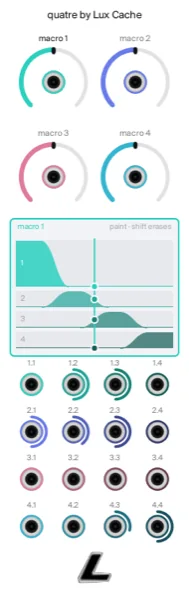
quatre
four macros, each a playhead over four painted lanes. paint a shape and sweep through it across sixteen outputs. smoothing turns a painted edge into a gate or a crossfade, and a rising saw into a macro’s CV jack makes each lane an LFO
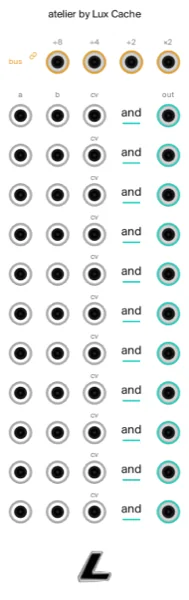
atelier
eight cells, two in and one out, each set to one of thirteen operations: logic, routing, sample and hold, a free-running rise and fall generator. a CV jack per cell moves the operation’s setting, and a top row divides the transport clock four ways
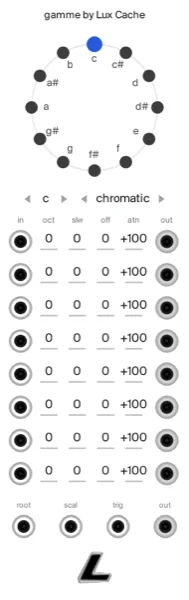
gamme
eight lanes pulled onto one scale, with an offset, octave and glide per lane. each lane is polyphonic to sixteen voices, a trig input holds them to a pulse, and foot sends the scale as voltages. the key is a bus the system follows

qmod
sixteen modulation sources in two columns of eight. each column takes one of six modes, or each slot its own, and each row has a rate knob that runs from a crawl to audio rate. seven LFO waveshapes, a trigger jack that resyncs the lot, and beside a qmap it reaches any knob without a cable

qmod+
sixteen more slots on a narrow panel with no knobs, and the same modes, shapes and ranges as qmod. beside a qmod it joins the bank, thirty-two slots on one set of knobs. alone, its own rate and a stagger spread all sixteen

qmap
sixteen CV inputs, each onto a knob it has learnt: modulation without a cable to the knob. every slot has an attenuator and offset, and at zero attenuation the offset is a remote knob. a qmod beside it feeds all sixteen

liasse
pick modules anywhere in the system and act on the group. re-roll them all, or walk them one at a time. a slew glides to the new settings, one toggle bypasses the group, and a second liasse takes eight more

sillage
two envelope followers, a and b, with separate timing, tracing how loud a sound is. dc coupling turns a follower into an envelope generator, the gate jack doubles as a noise gate, and a polyphonic input gets one per channel
what it sounds like
bully
grille fires fracas through foudre and pli, and a clap from bac into ruban. coupe strikes frappe into trame and feeds nef and presse, with qmod on presse, fracas and foudre, crible on the send and liasse rerolling on the beat.
159 artist designed presets
The artist preset collection in chassis explores the full potential of the system, from large modular patches to synth voices ready to play from the keys. Each preset carries a note on what is playing and what moves, and the whole collection comes with the full version.
Avenir
Palermo producer Avenir approached chassis as musique concrète. His patches start from recorded sound in coupe and work it over through echo, frequency shift and vocoder until the source is barely recognisable, most of them hung on a single macro that turns tape speed, cutoff and formant together.
one button randomises the system
One press of the dice rewires the whole system and re-dials every module, which no hardware setup can do. The algorithms behind it range from full chaos to tuned synth voices and genre-specific rules.
six designed randomisation algorithms
- full random
every parameter of every module, with the rails dialling it back
- synth voice
a playable instrument off the keys, not a patch that plays itself
- fx web
the voices kept, only the effects re-routed and re-dialled
- club anthem
four to the floor: a big kick, a bass that pumps under it, offbeat hats, a clap on two and four, stabs in key
- sampler explorations
a sample from the library, or a bar of the system recorded into the deck, chopped and sequenced in key
- mutate
the open patch, nudged: every knob already playing moves a little inside its rails
cmd R randomises one module, whatever the pointer is over, and leaves the rest of the system alone. Every press, whole-system or single-face, is one undo step.
chassisFX, the same system as an effect plugin
Two plugins share one system. chassis is the instrument, played from the keys or from its own sequencer, and it makes the sound. chassisFX is the same 34 modules as an insert, where the sound arrives from the track instead.
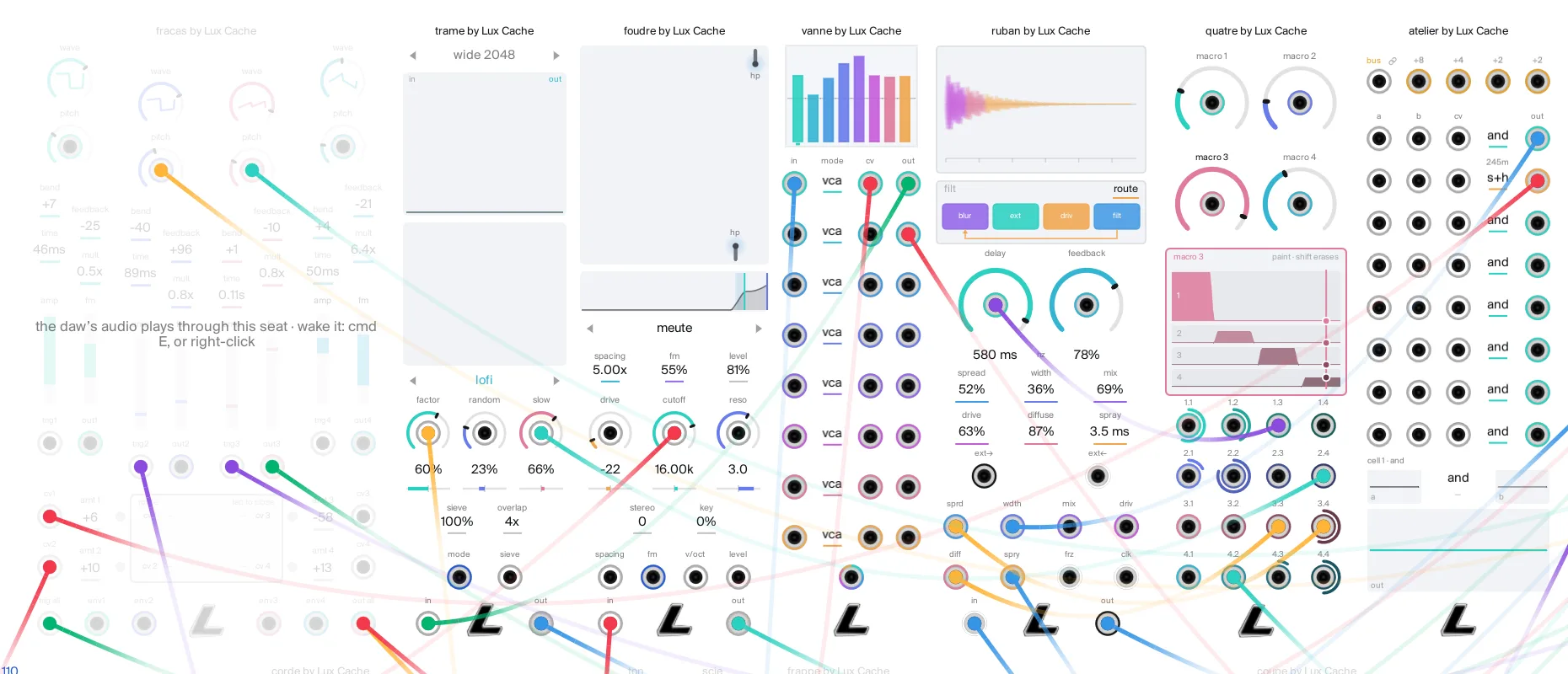
the sources stand down
on load, every sound source steps aside. its outputs carry the track’s audio instead.
presets still work
the track’s audio enters the patch where the synthesised voice used to sit. it travels the same cables, filters, delays and mixer channels, so a preset written for chassis works as an effect with no changes.
wake any of them
a module that has stepped aside wears a white wash and says so. cmd E, or its right-click menu, brings it back, and its own sound plays beneath the track’s audio.
learn inside the plugin
chassis carries its own manual: every module, control, menu item and jack, written as prose rather than as a parameter table. The panel beside the text is the system’s own, from the open patch, and whatever the words describe is outlined on its face.
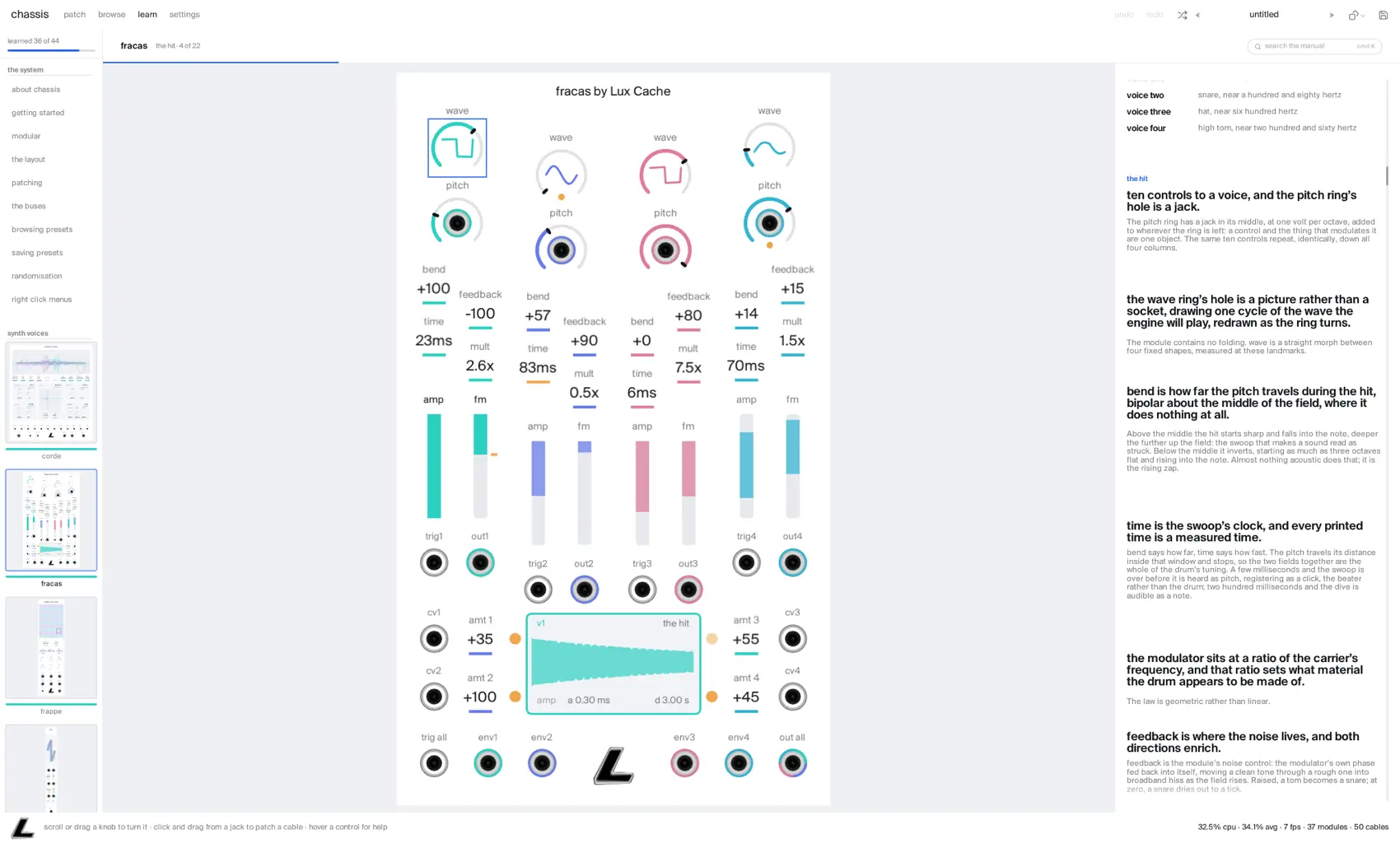
one continuous page
every chapter runs into the next. there is no next button and no page turn, and the only way through it is to read.
the whole tab is a sandbox
anything on that panel can be moved and none of it sticks. the patch is snapshotted as a module comes into focus and put back exactly as it was on leaving.
right-click into it
any module’s menu opens the manual at that module’s first chapter, so the question and the answer are one gesture apart.
search every word
cmd K reads the whole manual, not only the titles, and the results say which chapter each line came from.
Near the start is a chapter for people who have only used a DAW: how modular works, what a cable carries, why audio and control share the same jacks, and what each jack colour means. Most of it is familiar ideas under older names.
one system, wired a different way every time.
- —the chassis Standalone app + VST3 / AU plugin
- —chassisFX, the same 34 modules as an insert
- —34 module faces, and the manual for all of them
- —159 presets, and six ways to roll a new one
- —macOS and Windows
- —lifetime updates
Lux Cache Full Access subscribers and petri owners get chassis for $69, $10 off the list price.